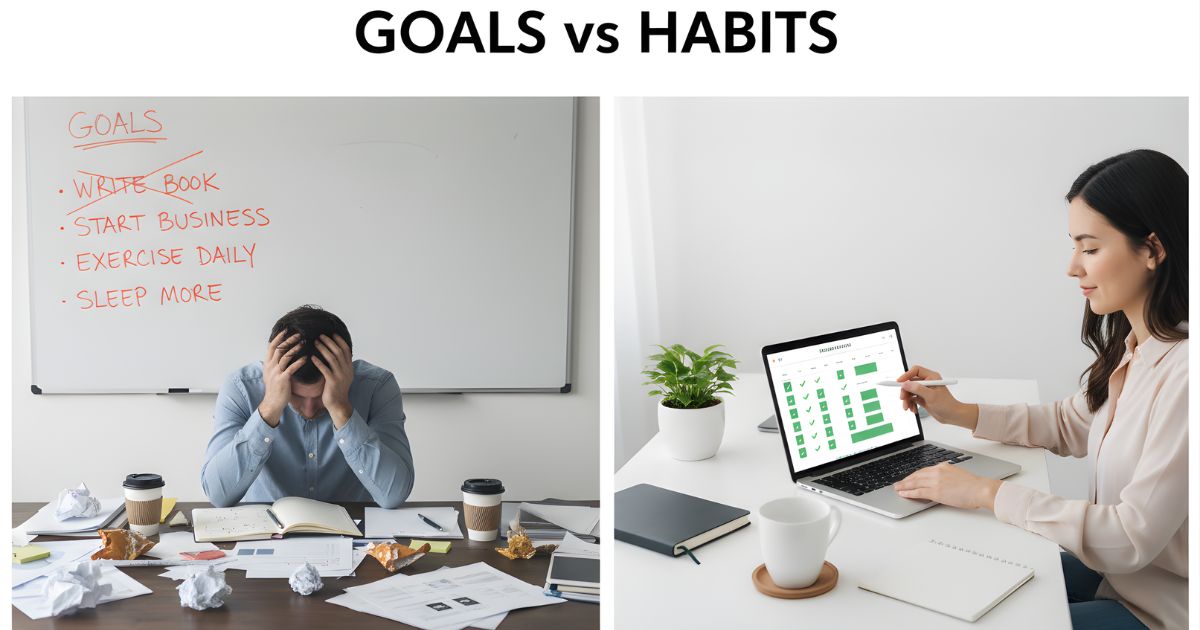
Walk into your workspace right now. Look around for ten seconds.
Now open your laptop. Look at your desktop. Check your phone home screen.
How do you feel?
If you're like most people I've coached over two decades, you probably felt one of two things: either calm focus or subtle, nagging overwhelm.
That feeling? It's not random. And it's definitely not in your head.
Your environment – physical and digital – is quietly programming your behavior every single day – and most people never realize it's happening.
The Uncomfortable Truth: Willpower Loses to Environment Every Time
Here's what I learned as an economist studying decision-making: people dramatically overestimate the role of willpower and dramatically underestimate the role of context.
We think we fail because we lack discipline.
The real reason? We're trying to build good habits in environments designed for bad ones.
You can't out-willpower a cluttered desk. You can't out-discipline a chaotic kitchen. You can't out-motivate a bedroom that screams "scroll your phone."
And you definitely can't out-focus a desktop with 47 browser tabs, 23 notification badges, and an inbox showing 1,847 unread messages.
Environment wins. Every single time.
The question isn't whether your space – physical or digital – affects your habits. The question is: are you designing it intentionally, or letting chaos decide for you?
Why Smart People Ignore This (And Suffer For It)
I've watched brilliant professionals – CEOs, engineers, lawyers, founders — pour energy into productivity systems, habit trackers, and morning routines.
Then they sit down at a desk covered in scattered papers, half-finished projects, and three weeks of coffee cups.
Their computer? Desktop files named "final_FINAL_v3_USE_THIS.doc" scattered everywhere. Email folders that haven't been organized since 2019. Twelve Slack workspaces with unread message counts in the hundreds.
And they wonder why focus feels impossible.
The irony? They'd never tolerate that level of disorder in their code, their contracts, or their business strategy. But their physical and digital environment? "I'll deal with it later."
Later never comes. And the mental tax compounds silently.
One client – a software architect who could hold complex system designs in his head – couldn't finish a single deep work session at his home office.
Why?
Physical clutter on his desk. Digital clutter on his screens. Visual chaos in both worlds creating cognitive load he didn't even notice. Every object in his peripheral vision, every notification badge, every "I should deal with that" file was a tiny decision his brain had to make: relevant or not? Important or not? Handle now or later?
We spent two hours decluttering both environments. Not reorganizing. Removing.
Physical: papers, old projects, unused equipment. Digital: desktop files into proper folders, inbox to zero, notification badges disabled, browser bookmarks pruned to essentials.
The next week, he completed more focused work than he had in the previous month.
Not because he suddenly got disciplined. Because we stopped asking his brain to fight friction it didn't need to fight.
The Science: How Physical Space Hijacks Your Brain
Visual Clutter = Cognitive Load (Both Worlds)
Research from Princeton University's Neuroscience Institute found that physical clutter competes for your attention, reducing your ability to focus and process information.
Psychology professor Sabine Kastner's 20 years of research shows that "the more objects in the visual field, the harder the brain has to work to filter them out, causing it to tire over time and reducing its ability to function."
The same principle applies to digital clutter. Your desktop icons, browser tabs, notification badges, and email count all compete for mental resources.
Think of your brain's attention like RAM on a computer. Every visible object – whether it's a coffee cup on your desk or an unread email badge on your screen – takes up processing power, even if you're not consciously thinking about it.
Clutter isn't just annoying. It's cognitively expensive.
And in the digital world, the cost is even higher because notifications and visual cues are specifically designed to grab your attention.
Your Environment Cues Your Identity
Habits researcher Wendy Wood at USC found that context is more powerful than intention when it comes to behavior change.
Your environment doesn't just affect your focus. It shapes your identity.
A cluttered, chaotic physical space tells your brain: "This is a person who's overwhelmed and behind."
A digital environment with 1,847 unread emails and a desktop full of unnamed files tells your brain the same thing.
A clean, intentional space – both physical and digital – tells your brain: "This is a person who has their life together."
You become who your environment says you are – whether that's true or not.
Decision Fatigue Starts Before You Think
Every item in your physical space that doesn't have a clear place creates a micro-decision: Where does this go? Do I need this? Should I move it?
Every file on your digital desktop creates the same drain: What is this? Do I need it? Which folder? Should I delete it?
Multiply those micro-decisions by dozens or hundreds of items across both environments, and you're burning mental energy before you even start your actual work.
Barack Obama famously wore the same suit every day to reduce decision fatigue. He understood what most people don't: every decision costs energy, even tiny ones.
Decluttering isn't about aesthetics. It's about removing decisions you don't need to make.
What Decluttering Actually Means (Hint: Not Minimalist Perfection)
Let's be clear: I'm not telling you to live like a monk or use a computer with zero files.
This isn't about throwing away everything you own or deleting your entire digital history.
Decluttering means: keeping what serves you, removing what doesn't, and organizing the rest so it's invisible until you need it.
It's not about perfection. It's about intentionality.
Ask yourself this: Does this item or surface – physical or digital – make it easier or harder to do the thing I want to do here?
- Your desk: easier or harder to focus?
- Your desktop: easier or harder to find what you need?
- Your kitchen counter: easier or harder to cook healthy meals?
- Your email inbox: easier or harder to respond to what matters?
- Your bedroom: easier or harder to wind down and sleep?
- Your phone home screen: easier or harder to do intentional work?
If the answer is "harder," you're not lacking discipline. You're fighting unnecessary friction.
My Client Stories: What Happens When You Fix Your Environment
The Founder Who Couldn't Focus
A startup founder came to me drowning in "productivity hacks." Pomodoros, time-blocking, app blockers – nothing stuck.
His office? A graveyard of unfinished projects. Whiteboards covered in six-month-old notes. Piles of "I might need this someday" papers.
His digital life? Worse. Desktop looked like a digital landfill. Browser with 67 tabs open. Three email accounts, none under 500 unread. Apps sending notifications every few minutes.
We didn't add another system. We spent an afternoon asking: "Does this help you build your company, or is it visual noise?"
Physical: We removed 60% of what was in that room. Digital: Cleaned desktop to 5 essential folders. Closed all tabs. Unsubscribed from 90% of emails. Turned off all non-essential notifications.
Three weeks later, his deep focus sessions went from 20 minutes (interrupted) to 90 minutes (sustained). Not because he got more motivated. Because we stopped forcing his brain to navigate an obstacle course just to think.
The Parent Who Reclaimed Evenings
A client with two young kids felt constantly behind on everything – work, health, personal finance, sleep.
The real issue? Physical chaos in the living room. Toys everywhere. No clear boundaries. Every surface was "temporary storage" that became permanent.
Digital chaos too. Phone constantly buzzing with notifications. Work email bleeding into family time. Apps she'd downloaded but never deleted cluttering her screens.
We created physical zones: play zone, reading zone, adult relaxation zone. Every item got a home, or it left.
Digital boundaries: Set app limits. Deleted unused apps. Created "work hours" and "family time" notification profiles. Moved distracting apps off the home screen.
Result? She could actually sit down and read for 20 minutes after the kids went to bed – something she hadn't done in two years.
Not because she found more time. Because both her physical and digital environments stopped screaming "you have work to do" every time she sat down.
Your Decluttering Action Plan: Start With One Surface
Don't try to transform your entire life in a weekend. That's how you burn out and quit.
Start with one surface – physical or digital, whichever causes you more daily friction.
Step 1: Pick Your Battleground
Choose one high-impact surface:
Physical:
- Your desk (if you work from home or do focused work)
- Kitchen counter (if you want to eat healthier)
- Bedroom nightstand (if you want better sleep)
- Entryway table (if you want calmer mornings)
Digital:
- Computer desktop (if files overwhelm you)
- Email inbox (if you're drowning in messages)
- Phone home screen (if apps distract you)
- Browser bookmarks (if you can't find what you need)
One surface. That's it.
Step 2: The Five-Box Method (Physical) or Five-Folder Method (Digital)
For Physical Decluttering:
Get five containers (boxes, bins, bags – doesn't matter):
- Keep (and use regularly) – Goes back, organized
- Keep (but store elsewhere) – Archive, garage, closet
- Donate/Sell – Still useful, just not to you
- Trash – Broken, expired, useless
- Decide Later – Can't decide? Put it here, revisit in 30 days
For Digital Decluttering:
Create five folders on your desktop or in your email:
- Active Projects – Files/emails you're working on now
- Archive – Completed work, keep for reference
- Delete – Outdated, duplicate, or useless
- Action Needed – Requires response/decision
- Review Later – Can't decide now, revisit in 30 days
Every item goes into one category. No exceptions.
The rule: If you haven't touched it in 90 days, it probably doesn't need to live in that space.
Step 3: Organize What Stays
Physical: Only put back items that:
- You use at least weekly
- Directly support the purpose of that space
- Make you feel calm (not guilty, not "I should")
Digital: Only keep visible what you:
- Access at least weekly
- Need for current projects
- Can't easily search for or recreate
Everything else goes into storage, archive, or leaves entirely.
Use decluttering tools to help: apps that gamify the process, digital organizers that track what you own, or simple habit trackers to maintain the space.
Step 4: The One-In-One-Out Rule
Physical: When something new comes into that space, something old leaves.
Buy a new book? Donate or archive an old one. Get a new mug? Old mug goes. Bring home papers? File or toss them that day.
Digital: When you download a new app, delete an old one. When you bookmark a new site, remove an outdated one. When you save a new file to desktop, archive or delete an old one.
This isn't about restriction. It's about equilibrium.
Your space stays functional because you're not letting chaos creep back in.
Step 5: Protect Your Win
Set a recurring calendar reminder – 10 minutes every Friday or Sunday – to reset both your physical and digital spaces.
Maintenance is easier than recovery.
One 10-minute reset weekly beats one 3-hour "deep clean" monthly – and it keeps the cognitive load off your brain the rest of the week.
Beyond Your Desk: Environments That Shape Other Habits
Physical and digital space doesn't just affect focus. It shapes every habit you're trying to build (or break).
Kitchen: The Eating Habit Battlefield
Want to eat healthier? Your kitchen tells you what to eat.
If cookies are on the counter and fruit is hidden in the back of the fridge, guess which one wins.
Simple fix: Put healthy food in visible, easy-to-grab places. Hide (or don't buy) junk food.
Your environment shouldn't require willpower. It should make the right choice the easy choice.
Explore nutrition tools that help you plan meals, track habits, and stay consistent.
Bedroom: The Sleep-Destroyer
Your bedroom is either a sanctuary for sleep or a multipurpose chaos zone.
If your bed is covered in laundry, your nightstand has work papers, and your phone is on the pillow next to you – you're programming yourself for terrible sleep.
Simple fix: Make your bedroom boring. Remove work, remove screens, remove clutter. One purpose: rest.
Pair this with sleep tracking tools that help you monitor quality and stay consistent.
Digital Workspace: The Focus-Killer
Your computer and phone are environments just like your desk.
A cluttered desktop with 100 files, a browser with 40 tabs, and a phone with notification badges on 20 apps destroys focus before you even start working.
Simple fixes:
- Desktop: Create folder structure (Projects, Archive, Resources). Move everything into folders. Desktop should have zero loose files.
- Browser: Use tab management extensions. Close all tabs at end of day. Bookmark only what you use weekly.
- Phone: Delete unused apps. Turn off all non-essential notifications. Move distracting apps off home screen.
- Email: Inbox zero isn't required, but inbox under 50 is. Use folders/labels aggressively.
Many people ignore digital decluttering because "it's not real clutter." But your brain processes digital visual chaos the same way it processes physical clutter – as cognitive load.
Explore digital wellness and screen detox tools that help you manage digital environments intentionally.
Workout Space: The Movement Motivator
I've never met someone who consistently exercised in a space where they had to move three boxes and clear laundry off the mat first.
Friction kills momentum.
If you work out at home, create a dedicated spot – even if it's just a cleared corner with a yoga mat.
Make it ready to go. No setup required. Just show up and start.
Check out fitness tracking tools that turn movement into measurable progress.
The Mental Wellness Connection: Why This Matters Beyond Productivity
This isn't just about getting more done.
Clutter – physical and digital – isn't just distracting. It's emotionally draining.
Research shows that people living in cluttered environments have higher cortisol levels – the stress hormone – throughout the day.
When you declutter both your physical space and your digital environment, you're not just organizing objects and files. You're reducing chronic, low-grade stress you didn't even realize you were carrying.
Every time you look at a pile of "I'll deal with that later" stuff – whether it's papers on your desk or files on your desktop – your brain registers it as unfinished business.
Remove the pile, remove the burden.
That's why mental wellness and decluttering aren't separate categories – they're deeply interconnected.
A clear space – both physical and digital – creates mental space for journaling, meditation, and gratitude practices that actually stick.
Common Questions About Decluttering and Environment
What if I live with other people who create clutter?
Start with your spaces – your desk, your nightstand, your side of the closet, your computer login, your phone.
You can't control others, but you can create zones that are entirely yours and protect those boundaries.
As people see the benefits (you're calmer, more focused, less stressed), they often become curious and start making changes too.
Model the behavior. Don't preach it.
What if I'm emotionally attached to things I don't use?
That's normal. Most clutter has emotional weight – gifts, mementos, "someday" projects.
Try this: Take a photo of the item. Keep the memory, release the object.
Or use the "box method": Put sentimental items in a box. If you don't open it in six months, you probably don't need what's inside.
You're not erasing memories. You're making room for new experiences.
How do I stop clutter from coming back?
Two strategies:
- The One-In-One-Out Rule (explained earlier) – maintain equilibrium
- The 2-Minute Rule – if it takes less than 2 minutes to put away or delete, do it now
The goal isn't perfection. The goal is a system that doesn't require heroic effort to maintain.
Use habit tracking apps to gamify maintenance routines.
What about digital clutter? Does that count?
Absolutely – and it's often worse than physical clutter because it's invisible but constant.
Your desktop, your email inbox, your phone home screen, your browser tabs – these are environments too.
Same principles apply:
- Does this icon/email/file/tab help me do what I want to do?
- If not, archive or delete it.
- Organize the rest so it's invisible until needed.
Digital decluttering often has faster impact than physical decluttering because you interact with digital environments constantly throughout the day.
Many digital organization tools can automate inbox management, desktop organization, and digital minimalism.
What if decluttering feels overwhelming?
Start ridiculously small.
Not "my whole house" or "my entire computer." Not "my whole room" or "all my email."
One drawer. One shelf. One surface. One folder. One app category.
Set a timer for 10 minutes. When it goes off, stop – even if you're not done.
The goal is momentum, not completion. Small wins build confidence. Confidence builds more action.
Celebrate progress, not perfection.
The Bigger Picture: Environment Is Infrastructure
As an economist, I look at habits the way I look at systems: what are the incentives, and what are the barriers?
Your environment – both physical and digital – is your infrastructure.
You wouldn't expect a business to thrive with broken equipment, chaotic processes, and no systems in place. Why expect your habits to thrive in cluttered, chaotic, friction-filled spaces?
Good infrastructure makes success inevitable. Bad infrastructure makes success exhausting.
The most successful people I've coached don't rely on motivation. They build environments – physical and digital – where the right choice is the easy choice.
They don't fight their space. They design it.
That's not privilege. That's strategy.
And you can start today – one surface at a time.
Your Space Is Your Silent Partner
Decluttering isn't about achieving some minimalist aesthetic that belongs in a magazine.
It's about creating an environment – physical and digital – that works with you, not against you.
Your habits aren't failing because you lack discipline.
They're failing because you're fighting unnecessary friction.
Stop fighting. Start designing.
Ready to Build Environments That Work?
Join thousands of professionals who get our weekly insights on habit-building tools, research, and strategies that actually work.
👉 Subscribe to Our Newsletter for more practical, no-BS strategies that actually work.
Or start decluttering today:
→ Browse Decluttering Tools
→ Explore Digital Wellness & Screen Detox
→ Explore Mental Wellness Resources
→ Discover All 630+ Tools
Let's build clarity, one intentional space at a time.
---
— Mi Rad
PhD Economist & Business Coach