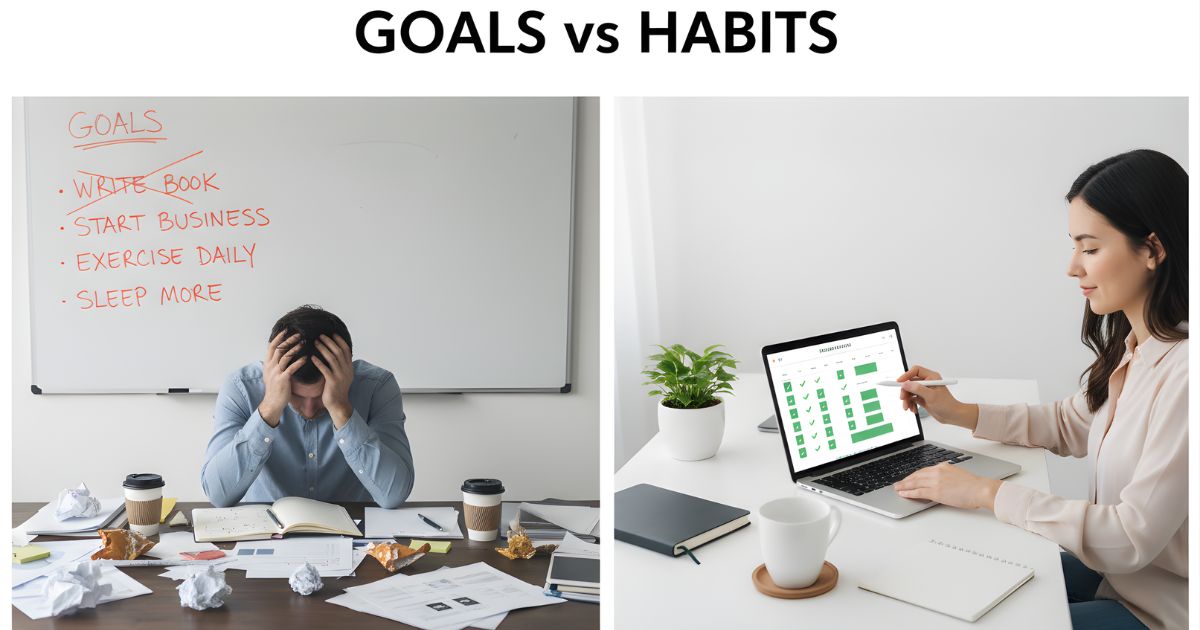
You plan your day with military precision. Meetings at 10. Deep work from 1 to 3. Gym at 6. Dinner at 8.
Then reality punches you in the face: meetings run over, a "quick task" eats your deep work block, the gym bag stays untouched in your trunk.
This isn't a productivity problem. It's a design problem.
The problem isn't you. The problem is treating your calendar like a wish list instead of a battlefield.
Your calendar isn't sacred. It's a guess. A rough draft.
Without real prioritization skills behind it, even the most beautiful schedule collapses.
My Wake-Up Call: From Hyper-Scheduled to Actually Productive
For years, I fell into the "hyper-scheduled" trap. As a business coach managing multiple clients, projects, and responsibilities, I thought discipline meant planning every hour.
What it really meant was daily frustration.
I'd blame myself when plans slipped. I'd stay later, sacrifice sleep, neglect my family, skip meals – all desperately trying to "catch up."
It took brutal self-honesty to admit: I wasn't bad at scheduling. I was bad at prioritizing.
As an economist, I should have known better. Every choice has an opportunity cost. Every "yes" is a "no" to something else. But I was treating my time like an unlimited resource instead of the finite, precious asset it actually is.
When I learned to prioritize ruthlessly – to make peace with the fact that not everything would get done – my schedule finally started working for me instead of against me.
That same transformation happened with hundreds of professionals I've coached over 20 years. The ones who thrive? They don't try to do everything. They design their days around what actually matters.
Why Most Schedules Fail
They Assume Perfect Conditions
Your calendar shows you working in an ideal world: no interruptions, no delays, no energy crashes, no unexpected fires to put out.
But you don't live in an ideal world. You live in reality – where meetings run long, colleagues need "just five minutes," and your brain hits a wall at 3 PM.
Planning for perfect conditions guarantees failure in real conditions.
They Don't Differentiate Priorities
Most schedules treat every task equally. Responding to non-urgent emails gets the same weight as strategic planning that could reshape your career.
The result? Minor errands become productivity black holes while your most important work gets pushed to "tomorrow."
When everything is important, nothing is important.
They Lack Recovery Space
Back-to-back scheduling ignores a fundamental truth: your brain has natural rhythms of focus and fatigue.
Research from the University of Illinois shows that brief diversions from a task can dramatically improve your ability to focus on that task for prolonged periods. (source)
You can't sprint for eight hours straight. Yet most calendars are designed exactly that way.
They Mistake Activity for Achievement
A full calendar feels productive. It looks impressive in meetings. "Look how busy I am!"
But busy doesn't mean effective. Activity doesn't equal achievement.
I've coached executives with 60-hour workweeks who accomplished less than colleagues working 35 hours – because the 35-hour workers knew how to prioritize.
The question isn't "How much did I do?" It's "Did I do what mattered most?"
The Economist's Perspective: Your Time is a Finite Resource
Here's what changed my entire approach to scheduling: thinking like an economist about time.
Time is your most valuable non-renewable resource. You can't buy more. You can't save it for later. Every hour spent on one thing is an hour NOT spent on something else.
This is called opportunity cost – and most people ignore it completely when planning their days.
When you say yes to a 30-minute meeting that could have been an email, you're not just spending 30 minutes. You're choosing NOT to spend those 30 minutes on:
- Strategic thinking
- Deep creative work
- Rest and recovery
- High-value client work
- Actually solving problems
Every calendar entry represents a resource allocation decision. Most people make these decisions unconsciously, reactively, based on whoever asks loudest.
Effective professionals make these decisions consciously, strategically, based on what creates the most value.
The math is brutal but clarifying: You have roughly 4,000 weeks in a lifetime. How many of those weeks will you waste on poor prioritization?
The Real Art of Prioritization
The Eisenhower Matrix: Urgent vs. Important
One of the most powerful prioritization frameworks remains the Eisenhower Matrix, named after President Dwight D. Eisenhower.
The framework separates tasks into four quadrants:
Quadrant 1: Urgent and Important
- Crises, deadlines, emergency problems
- These demand immediate attention
- Example: Client emergency, critical bug fix
Quadrant 2: Not Urgent but Important
- Strategic planning, relationship building, learning, prevention
- This is where real value gets created
- Example: Developing new skills, exercise, long-term planning
Quadrant 3: Urgent but Not Important
- Interruptions, some emails, some meetings
- They feel pressing but don't move the needle
- Example: Most "quick questions," non-essential meetings
Quadrant 4: Neither Urgent nor Important
- Time wasters, busy work, excessive social media
- Pure productivity drain
- Example: Mindless scrolling, unnecessary reports
The trap: Most people live in Quadrants 1 and 3 – constantly reacting to urgency while ignoring importance.
The solution: Protect Quadrant 2 time fiercely. This is where growth happens. (source)
Energy Management Over Time Management
You can't manage time. Time moves at the same rate for everyone.
What you CAN manage is your energy and attention.
Research shows that willpower and decision-making ability deplete throughout the day. (source)
This means:
- Your hardest, most important work should happen during your peak energy hours
- Low-energy tasks (admin, emails, routine work) fit better in your energy valleys
- Trying to do deep strategic thinking at 4 PM when your brain is fried is wasteful
Track your energy for one week. Note when you feel sharpest and when you hit walls. Then design your schedule around those patterns, not around arbitrary clock times.
I do my most demanding cognitive work between 8 AM and 11 AM. Always. That's my Quadrant 2 fortress. Everything else flows around it.
The "One Big Thing" Rule
Every day, identify your One Big Thing – the single task that, if completed, would make the day a success regardless of what else happens.
Not three big things. Not five priorities. ONE.
This forces clarity. It forces choice. It forces you to ask: "If I could only accomplish one thing today, what would move the needle most?"
Everything else is secondary.
Scheduling That Actually Works
Time Blocking with Strategic Buffers
Time blocking works – but only if you build in reality.
How it fails: You block 9-10 AM for "deep work" but a meeting runs over, someone stops by your desk, you need coffee, you check one email that spirals into fifteen, and suddenly it's 10:15 and you haven't started.
How it works: You block 9-11 AM for deep work, knowing the first 15-30 minutes are buffer time. The actual deep work happens 9:30-11. Now you have breathing room for life's inevitable friction.
Buffer rules:
- 10-15 minutes between meetings (minimum)
- 30-minute buffer blocks between major work sessions
- One full hour of completely unscheduled time per day
- Built-in slack for when things take longer than expected
Use tools from our Time Allocation category to experiment with different blocking strategies.
Theme Days vs. Task Days
Instead of fragmenting your days across multiple contexts, consider grouping similar work:
Monday: Client-facing work (meetings, calls, presentations) Tuesday: Deep strategic work (planning, analysis, writing) Wednesday: Creative work (brainstorming, innovation, learning) Thursday: Execution and follow-through Friday: Wrap-up, review, planning next week
This reduces context-switching costs. Your brain stays in one mode instead of constantly shifting gears.
Not every role allows this level of theming, but even small moves toward batching similar tasks create massive efficiency gains.
The 2-Minute Rule (But Not How You Think)
The 2-Minute Rule says: if something takes less than two minutes, do it now.
That's terrible advice for focused work.
Better rule: If something takes less than two minutes, batch it with other 2-minute tasks during a designated admin block. Don't break deep focus for two-minute tasks.
Protect your deep focus time like it's oxygen – because it is.
Weekly Reviews: The Non-Negotiable Habit
Once per week, spend 30 minutes reviewing:
What worked:
- Which tasks got done?
- What made progress smooth?
- When did you feel most productive?
What didn't:
- What didn't get done (and why)?
- Where did time leak?
- What drained energy unnecessarily?
Next week's priorities:
- What's the One Big Thing for each day?
- Where are the known conflicts or challenges?
- What needs to be said "no" to?
This isn't optional. It's the habit that makes all other scheduling and prioritization habits possible.
Use a journaling tool or simple notebook to track these weekly reviews. The insights accumulate over time.
Your Action Plan: Start Today
Step 1. Audit Your Last Week
Pull up last week's calendar and honestly assess:
- How much time was spent on Quadrant 1 (urgent + important)?
- How much on Quadrant 2 (not urgent but important)?
- How much on Quadrant 3 (urgent but not important)?
- How much on Quadrant 4 (neither)?
The goal: Increase Quadrant 2 time, decrease Quadrant 3 and 4.
Consider using time tracking tools for more accurate awareness of where your hours actually go.
Step 2. Define Your One Big Thing for Tomorrow
Before you end today, write down: "If I accomplish only one thing tomorrow, it will be ________."
Be specific. Make it meaningful. Make it achievable in one focused session.
Tomorrow morning, protect that task like your career depends on it – because it often does.
Step 3. Block Your Peak Energy Hours
Identify your 2-3 hour window of peak cognitive energy. Mark it on your calendar as "DEEP WORK - DO NOT SCHEDULE."
Treat this block as sacred. Turn down meeting requests during this time. Close email. Silence notifications.
This is your Quadrant 2 fortress.
Step 4. Build Buffers Into Every Day
Look at tomorrow's calendar right now. Add:
- 15-minute buffers between back-to-back commitments
- One full hour of unscheduled flex time
- 30-minute recovery after high-energy activities
This isn't wasted time. It's the shock absorber that keeps your whole system from breaking.
Step 5. Practice Saying No (Strategically)
Not every meeting request deserves a "yes." Not every project deserves your time.
Script: "I appreciate you thinking of me for this. Right now, I'm focused on [your One Big Thing/priority]. I need to pass on this to protect that commitment."
Saying no to good things creates space for great things.
Step 6. Use Tools That Help, Not Hinder
The right scheduling and prioritization tools can dramatically reduce friction:
For scheduling:
- Explore options in our Scheduling category
- Look for tools that support time blocking and buffers
- Find calendar systems that integrate with your workflow
For prioritization:
- Check our Prioritization category
- Try tools that help you identify your One Big Thing
- Experiment with Eisenhower Matrix apps
For tracking and awareness:
- Browse Time Tracking tools
- Monitor where your time actually goes vs. where you think it goes
- Use data to make better scheduling decisions
Common Questions About Scheduling and Prioritization
How do I handle when everything feels urgent?
First, recognize that "urgency" is often artificially created.
Ask: "What happens if this waits 24 hours? 48 hours? A week?"
Most "urgent" things aren't. They're just loud.
For genuinely urgent situations, batch them into a dedicated "fire-fighting" block rather than letting each one fragment your entire day.
The real fix: Spend more time in Quadrant 2 (prevention, planning, systems) so fewer things become genuinely urgent.
What if my job doesn't allow control over my schedule?
Even in heavily meeting-driven roles, you usually have more control than you think.
Strategies:
- Block 30-60 minutes daily as "unavailable" (before most people start or after they end)
- Batch meetings on certain days to protect other days
- Negotiate one "no-meeting day" per week with your team
- Push back on unnecessary meetings (suggest email updates instead)
The key: stop asking for permission to protect your time. Start politely but firmly claiming it.
How do I prioritize when multiple things ARE truly important?
Use the "forced ranking" technique:
If you could only complete ONE of these important tasks, which creates the most value? That's #1.
If you could only complete ONE of the remaining tasks, which comes next? That's #2.
Continue until everything has a rank. Now you have a clear priority order instead of five equally weighted "priorities."
Remember: Priority (singular) is what matters. Priorities (plural) is just a disguise for "I haven't made hard choices yet."
Should I schedule personal habits like exercise or sleep?
Absolutely yes.
Exercise and sleep aren't luxuries to fit in "if there's time." They're the foundation that makes everything else possible.
Schedule them first, like non-negotiable meetings with yourself.
If you wouldn't skip a meeting with your CEO, don't skip your workout or sleep window.
How often should I review and adjust my schedule?
Daily: Quick 5-minute review each evening (What worked? What's tomorrow's One Big Thing?)
Weekly: 30-minute deeper review (What patterns emerged? What needs to change?)
Monthly: 60-minute strategic review (Are my priorities aligned with my bigger goals? What systems need adjustment?)
Quarterly: 90-minute complete reset (Is my overall time allocation serving my life goals?)
This creates multiple feedback loops at different time scales. Your schedule becomes a learning system, not a static wish list.
The Bottom Line: Your Calendar is a Design Problem, Not a Discipline Problem
You don't need more willpower to stick to your schedule.
You need a better schedule – one designed for humans, not robots. One that acknowledges energy patterns, builds in recovery, differentiates priorities, and accepts that life is messy.
Your calendar isn't sacred. It's a tool.
The real art lies not in cramming it full, but in shaping it around what truly matters to you.
No perfect schedule exists. But a schedule that honestly reflects your priorities, respects your energy, and builds in breathing room?
That's a schedule that survives real life.
Ready to Stop Fighting Your Schedule and Start Designing It?
Join thousands of professionals who get our weekly insights on time management, prioritization, and productivity strategies that actually work.
👉 Subscribe to Our Newsletter - One email, once a week, zero fluff.
Or dive straight into action:
→ Browse Scheduling Tools
→ Explore Prioritization Tools
→ Discover Time Allocation Strategies
→ Discover All 630+ Tools
Let's build calendars that serve us, not enslave us.
---
— Mi Rad
PhD Economist & Business Coach